8/20/2015

Along Pennsylvania's Wissahickon Creek


BOOK "Wissahickon Souls: A Wissahickon Creek Story"
Possibilities Publishing 2014 
346 pp. Fiction
www.possibilitiespublishingcompany.com

The subtitle "A Wissahickon Creek Story" sets the scene for the story of the life of Claire Penniman, a black woman born free in 1806. The story is fiction, but it is based on historical research, and the Wissahickon still flows today in the Germantown and Philadelphia areas of Pennsylvania ( see https://en.wikipedia.org/wiki/Wissahickon_Creek). An excursion seems in order after reading this book.
The author, PJ Devlin, researched the lives of black and white Philadelphians in the early 19th century before writing. She recalled fondly her childhood recollections of a local farm and playing along the creek. This comes through vividly in her story about Claire, who enjoyed playing in and walking along the creek. I wanted to explore the creek, to feel the wet stones under my feet and the cool water rushing over them.
Claire Penniman was indentured to a white farm family from a very young age through age 16. Her parents had decided that her life would be better--she would get decent food and shelter--if she lived as a servant on the farm. Her parents were hard-working people whose ancestors had been acquainted with William Penn. Yet as blacks, their options to succeed were limited.
Precocious Claire did far more than her share of chores for her masters, but she was known as one with a wild streak, an independent young person who spoke their mind.  Children were not children in these times; they were people expected to earn their own way. She did so, without complaint.
She fell in love with the son of the owner of the farm, and his family did not condone their eventual interracial marriage. After deep thought on the subject, Claire and her husband moved to Haiti, which welcomed American blacks. Their life was difficult, but they persevered. They raised two children, one white and fair-haired like his father, the other dark. Claire's anguish during her daily travails wrenches the heart of any mother.
PJ Devlin is a skillful writer. Halfway through, I could not put the book down--I cared so much about Claire and was cheering for her to prevail over her hardships.
The story ends with the reader wondering what the rest of young Claire's life will be like. Is a sequel in the making? One can hope so.
(Sue Kovach Shuman)

5/10/2015

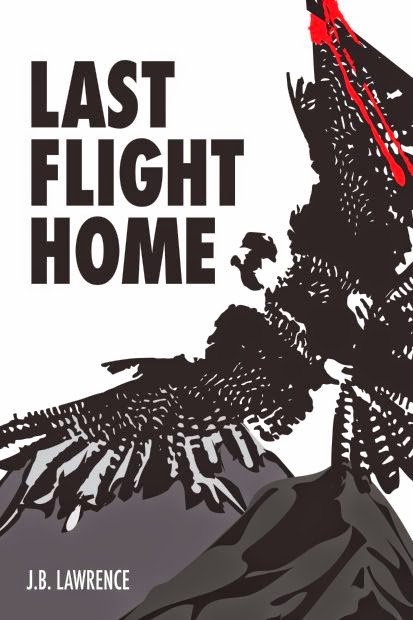
"Last Flight Home": Perfect for Travel

BOOK REVIEW of 
"Last Flight Home" 
by J.B. Lawrence

(Possibilities Publishing Company, 180 pages, $10.99)


Imagine an upside-down world where people have adapted by learning how to climb steep cliffs like billy goats, using no ropes or other gear, with lungs that thrive on the thin air. Like the falcons they revere, they soar along cables and gondolas across mountain ranges, entire armies transported and waging warfare from above. Their enemies fashion catapults and toss boulders.But--surprise!--some boulders are alive.

This is the kind of book that sucks you in--perfect for airports and plane rides. The content is meaty enough to keep you turning pages, but not so cerebral that you close the book.

In a world with five moons and one hot sun, the extremes of high and low temperatures have forced peoples to invade other regions to survive and preserve their own species. The time fame is unclear, but one supposes it's before or after a long-ago Ice Age. Alongside humans live giants composed of granite, some of them fond of  decapitating men, winged insects that feast on humans, and indeterminate blood-sucking creatures. 

It's a classic tale of good versus evil, but with twists. The narrator and main character, Prince Tyrcel Buteo, has been sent on a falcon hunt. He's under the spell of a sorcerer for much of the novel, sick and getting sicker. Since he's human, there's lots of gore and blood and vomit as his insides rot from infection. But he bands with nerdy boy geniuses who discover clever ways to foil their enemies as he heads back home. 

The helpful hand-drawn map at the beginning of Chapter 1  sketches the regions, and I kept returning to it to follow Tyrcel's travels. The author likely conceived his fantasy world long before he set words to it. Oddly, this world seems flat, and since ships topple from skies, it's a bit confusing. Still, it's a fun read, and impossible not to cheer for Good Prince Tyrcel.

His father dead, the new young king vows to protect his people, realizing that other beings, human or beast or whatever, are in the same boat. He'll do whatever it takes. The novel ends on the battlefield--a cliffhanger where the reader isn't sure who'll win. Perhaps this is the beginning of a series of fantasy books exploring universal themes in a world where beings adapt in outrageous ways to survive.

WIN A COPY OF THE BOOK

Be among the first to read "Last Flight Home," published May 15, 2015 by Possibilities Publishing Company.

Send your idea for a fantasy story set in the future with a female protagonist. Entries are due no later than June 20, 2015. Winner will be contacted via email and winner's name announced on this blog (with permission). 

4/15/2014

Cheap Is Good

I save the oldest hole-y underwear for trips, wear them twice (inside out and seams in), and toss...

save hotel-size plastics with toiletries and reuse (with Dollar Tree shampoo and soaps) and recycle the containers when they break...

pack my own homemade coffee cake and cut veggies and cheese and crackers for the plane ride...

check free and reduced-price admission days for museums and sites around the nation and world before booking a trip....

check hotel consolidators and Trip Advisor and Hotels.coms and at least 10 independent and chain hotel websites before booking....

and that's just for starters.

Yes, my children and husband are probably shaking their heads (or hiding them in shame). But we have been able to travel to many places (Paris, Greece, the American Southwest, national parks) and see many things because I'm cheap. My parents were children of the Great Depression. I'm a child of the (2000s) Recession. Put that together and you get the Reduce, Reuse, Recyle, or Do Without School of life--proud of not using more than one person needs to, and maybe not polluting the planet much.

But I KNOW I'm not the smartest person on this planet. Get reminded of that every single day in the Washington, D.C., area, where lots of smart people come to make their mark. I love Hints From Heloise, the American advice column where people share their tips for economical or practical living--things like reusing toiler paper rolls to store scarves, or plastic bags for things that I am sure God did not intend them for, and She would be appalled.

Lots of travel websites give advice on cheap tips. I want yours, and will publish them with with your email, spreading the gospel of Dirt Cheap Travels far and wide. You know you've got great ideas. Share them. Cheap is good! More travel is good.

THE CHEAP TRAVEL LIST begins here. It's April 15 (tax deadline day in the U.S., when people are either deciding where to travel to spend their refunds or starting to think about a Cheap Trip because they have to pay $ in and have no $).

Send them to me in Comments (below). Here's a photo to inspire you (from a plane at the Marine Corps Museum in Quantico, Va., always free):


4/10/2014

Truth in Travel, Plus Free National Parks

No crap. No lies. No fudging the facts. That's what travel writing should be about.
The first time an editor for a travel section said I should write about a place I'd never visited, I thought he was kidding. I should make a few calls and check websites and come up with something creative, he said.
I was surprised and dismayed. But the truth, I've learned, is that some travel writers never actually go to a destination. Travel costs money, and writers aren't paid as much as, say, software experts (or even ministers, as I learned on one Illinois trip).
It's dishonest to write about a place and a culture unless you have firsthand knowledge. Of course, there is a difference between writing generically about a place--the name, attractions, hours, costs, etc.--without having an opinion, as publications online and in print often do. But why bother writing about a place unless you can impart a tiny bit of feeling?
As a writer, I've been offered free trips to places near and far--Philadelphia, Colorado skiing, Greece, to name a few. But I don't accept them. Paying my own way allows me to be honest about something if it isn't good, to say an overpriced meal isn't especially tasty, that the hotel room blanket had two fleas (that was in 2013 in Thermopolis, Wyoming).
Writers are careful about their words to avoid lawsuits. Freelancers aren't protected by the legal staffers of large news organizations. It's a bigger challenge to find words that describe lousy or inadequate experiences that those that are pleasant. The glossy Travel magazines rarely have bad reviews; they'd lose advertisers and be sued.
Even large news operations have limited budgets. Many rely on freelance writers, who must pay for the costs of their airfare, gas, hotel, meals, and admissions, and still try to make a tiny profit that pays the rent or mortgage. Often, there's none.
I'm cheap. Frugal. Thrifty. My daughter remembers being told to slump down in the minivan's backseat while on a cross-country trip so that she looked younger than 12 (thus avoiding paying the adult fee at a hotel). While other families paid for fast-food fountain-drink sodas and burgers, my family shared 2-liter iced tea in reusable plastic cups (free from the hotel), sandwiches made with grocery-store cheese, and fresh fruit. Sitting inside a burger joint cannot compare with a picnic lunch at a roadside rest stop or small-town city park where you might meet the mayor on a stroll or a friendly dog.
From the Grand Canyon to Beijing, it's possible to enjoy the best of a place while economizing. Almost everywhere in the world, an independent traveler can thrive while being cheap. Sweat the big stuff, not the small.
See as much of the world as you can now. Don't wait for retirement to take one guided trip. Take a bus, a train, a one-hour getaway today to a place you've been meaning to, but just cannot find the time or money.
I'll share cheap tips (see my old 4/27/10 Anti-Packrat Travel post for some ideas). 
  
Send your favorite along and we'll make a list so you can stretch those dollars.

Here's one priceless experience: In Yellowstone National Park, a buffalo rested near the men's room. (That's my husband on the right.) Nobody bothered the buffalo.


AND NOTHING IS BETTER THAN FREE! The National Park Service was late this year in announcing its fee-free park week. Not until March 27 did it announce that not only would April 19 and 20 be free days, but that the following week (April 19 through 27) would be included. (Since Easter is April 20, is this good or bad?) Yellowstone, anyone?

Escape From It All: Recharge the Soul

I'm no longer exactly into roughing it with a backpack through backcountry, but there are beautiful, remote places where it's still possible to get off the electric and other grids and return to simpler times.

Even cellphone reception is iffy in many places, some on federal land.

Sometimes a soul needs to recharge close to the ground, under the skies, with few distractions. Every day, many of us turn to email, social media, websites, television, Skype, etc. to learn about what's going on in the world and to stay connected with people. It is even possible for many of us to have Facebook friends who we've never met and may never meet, to be on groups with people we have little in common with.

On my search for such spots to recharge, here's a favorite.


Most days, Thunder Basin National Grassland in Wyoming has more cattle and rattlesnakes than people. Mornings, I woke before dawn to cows mooing. Nights, the sky turned more colors than I knew existed. Stars are so close that I felt I could catch one in my hand.

Summer days can be brutally hot, winters harsh. There isn't much in the way of entertainment. You can walk, sing aloud even if you don't have the voice for it, read a book inside the tent, open a can of beans for dinner (no campfires in this dry-grass country). Make sure you stay on federal land. Property owners here don't take kindly to trespassers. They carry big guns and display them prominently in their pickup trucks.

What a gorgeous place they've got.


3/26/2014

The Sixth Decade

Like many things in life, the thought often is better than the reality. I was pondering an appropriate way to commemorate reaching age 60--a bungee jump, a Death Valley trip, a visit to a remote national park overseas, walking through a string of antique shops, maybe just walking a beach shoreline.
I did none of that. That's for 61. Or later.
Also, it was friggin freezing outside. My son and daughter-in-law treated me to dinner at a French restaurant in Alexandria, Va. -- profiteroles instead of birthday cake. Yum. (On my 50th birthday, I flitted from tapas bar to tapas bar in Madrid, where I learned that even tiny glasses of beer and wine with garlicky shrimp and patatas can get you tipsy.)
The problem with being 60 is that I suppose I should start a bucket list, but when I learned that it is trendy or trending or whatinhell you call it, I decided to be no part of it.
Being 60 means listening to the beat of my own drum, dissonant as it may be. Here goes.

This is me getting lost somewhere. Call me the Anti-Fashionista. It is truly hard to believe that I lived in Paris for four years and once wore tiny black skirts and velvet red high heels.

Cheap Staycation: Walk My 'Hood

I love getting away, but sometimes it just isn't possible for health, money or other reasons (and sometimes I just like the comforts of home). So I've been exploring my suburban Washington, D.C., neighborhood. It's called Mantua and is in Fairfax County, in northern Virginia.

I know that the term staycation has fallen out of favor, but I can term my explorations as such because that word fits. Truly, I am lucky to live in wooded hills packed with wildlife. Last weekend while on a walk, a raccoon peeked out of a storm drain pipe. Red foxes walk through my yard every day, searching for squirrels too stupid to stay on trees. There are baby foxes, I suspect, in the yard in back of mine.

There's a Lotte Korean grocery store on one edge of the 'hood. I walk there to buy fresh inexpensive vegetables and fish. A Trader Joe's is at another end of the 'hood; that's where I go for cheap wine and wonderful cheeses. A post office is on the same road. My neighborhood has 1,550 houses (more households, if you count apartments within some and multi-family living situations), yet there is no blue mailbox to deposit mail. Even with online bill-paying and email correspondence, it would be nice to have a place to deposit a birthday card or sympathy card. (I hope that even the most social-media conscious among us dares not send email when someone loses a family member of friend. Then again, I fear I'm just a dinosaur for thinking that people like to actually talk to people.)

Mantua's boundaries roughly are between Route 236 (Little River Turnpike), Route 50 (Arlington Boulevard), Prosperity Avenue and Pickett Road. Each of these carries lots of cars. Usually I am the only one walking on them. My explorations will go as far as I can, now that this long winter with snow still on the ground on March 26 has turned to Spring.


12/28/2012

Berlin Like a Local

Whoa! It's a sunny day with blue skies in Berlin, a rarity in this city during the winter. Daylight lasts from about 8 a.m. to 4:15 p.m. now, the last week of December. A few Christmas markets are still operating in tourist areas, but most vendors have closed shop until next year. The last Sunday of the month in Spandau, vendors slashed bratwurst prices to 1 euro and wooden Christmas ornaments were half price. But with a steady rain, we were chilled and sought refuge at Hasir, a chain restaurant where hot lentil soup with hearty rolls and stuffed grape leaves made a perfect lunch.

Winter might be the ideal time to live like a local, experiencing the after-holiday reality of everyday life.   
I've visited most of the top tourist sites before--Brandenburg Gate, Checkpoint Charlie, sections of the Berlin Wall. This time I'm going to focus on "free" Berlin, the tiny museums and monuments and neighborhood events and shops that keep locals connected to their roots. 

But that doesn't necessarily mean bratwurst and beer. I'm staying in a neighborhood with a heavy Turkish influence, where some donor kebab eateries are open 24/7 and greengrocers (4 big ones within 3 blocks) compete to sell the freshest spinach, clementines and tomatoes that I've ever seen during winter. When I lived in Paris, I enjoyed stopping at the grocer's or buying fruit and vegetables from street vendors. I miss that in the United States, where items at outdoor markets are often pricey. 

Having a kitchen to cook in is a bonus here, though my son-in-law's creative vegetarian dishes put my simple fare (such as potato latkes) to shame. He has made roasted vegetable strudel, red-pepper and mushroom pizza, crepes stuffed with spinach and tomato, cumin-scented chickpea stew, babaganoush and hummus. The bagels he made this morning, after a trip last night to a BioMarkt (which specializes in organic and healthy products) for malt and protein flour, could win a bagel contest.

Berlin is best seen on long walks through the Tiergarten, especially in early evening when the old gaslights are lighting up, or in the ornate gardens at Charlottenburg Schloss, where ducks and swans greedily nibble your stale bread. 

Maybe it's because I was raised Roman Catholic, but I've always liked old churches. With my daughter and son-in-law, I attended the Christmas Eve service at the Berliner Dom, where statues of Luther and Calvin are perched on pedestals high above the congregation. Gold glitters in the dome, and the massive organ seems to thunder even when played softly. 

On to today's adventures. 


11/16/2011

Volunteer on Vacation

One of the best ways to feel that you make at least a small difference in the world is to take a volunteer vacation. Some people pay thousands of dollars to go to an undeveloped country and help build a school, for example.

Some established tour operators charge less encourage you to live like a local, but your accommodations may be spartan. If you don't have an adventurous spirit, fugeddabouddit.

If you don't mind doing without some creature comforts, but do appreciate the little luxuries in life (a hot shower at a campsite, for instance), a volunteer vacation may be right for you. Decide what you want to do--tutor children, paint a school, etc.--then Google like crazy while searching for opportunities.

DO NOT confuse volunteer vacations with "free" ones. For example, the USDA Forest Service invites applications for archaeology and historic preservation projects nationwide through its Passport in Time (PIT) program. Although there is no participation fee, you usually pay transportation costs to get to a site, your own food, and for lodging. (Sometimes, camping is free at Forest Service campgrounds!) You'll meet like-minded, interesting people with a bit of an adventurous spirit. Swapping stories around a campfire with S'mores is fun at any age!

In 2009 I was lucky to be chosen to participate in a Forest Service archaeological project in the Laguna Mountains of southern California. As a federal government volunteer employee for a week, I helped document sites where native peoples milled nuts and seeds. It was chance to see the land with new eyes. That week changed my life. Since I love history, travel, and and being outdoors, the week passed quickly.

To learn more about that trip, follow this link: http://www.washingtonpost.com/wp-dyn/content/article/2009/12/11/AR2009121102131.html

Since then, I've been lucky to be accepted on other Forest Service projects, such as this one

http://www.passportintime.com/summaries/2011/hopevalleyarborglyphs2011.html

and  this one

http://www.passportintime.com/summaries/2011/bendguard2011.html 

With these PIT opportunities, I've slept in a tent in a bear-habitat campground and among cows and rattlesnakes on grasslands--by choice. (I could have stayed in motels.) As work colleagues know, my motto is: What doesn't kill you makes you stronger!

Mid-Atlantic Travel Ideas

Bored? If you live in the Mid-Atlantic region, you shouldn't be. Here are a few places to go, with links to details about them from published stories written by this freelance writer:

Hopewell Furnace National Historic site
to pick apples in a 19th-century-style orchard:

The Underground Railroad in Blairsville, Pa.
http://www.washingtonpost.com/lifestyle/travel/escapes-going-underground-in-blairsville-pa/2011/08/12/gIQAvwOGeJ_story.html

Pennsylvania Dutch country:
http://www.washingtonpost.com/lifestyle/travel/escapes-hunting-for-hex-signs-in-pennsylvania-dutch-country/2012/03/28/gIQANULviS_story.html  

Richmond, Va., slave trail
http://www.washingtonpost.com/lifestyle/travel/escapes-in-richmond-following-the-footsteps-of-the-slaves/2011/04/12/AF0rlpJE_story.html 

Richmond, Va., State Capitol
http://www.washingtonpost.com/wp-dyn/content/article/2007/05/15/AR2007051501944.html http://www.washingtonpost.com/wp-dyn/content/article/2007/05/15/AR2007051501944.html

Richmond, Va., Virginia Historical Society (March 5, 2010, The Washington Post)
It looked like a fossilized animal dropping on red fabric inside a black-frame box. I wondered, "Why do people keep things like that?" Then I read the handwritten description: "Original Civil War twists of tobacco from the tobacco warehouse in Richmond." Aha. That's why.
Near the box with the twists stood tins of Pride of Virginia chewing tobacco as well as relics of tobacco's legacy, such as a cigarette pack depicting a child smoker and brands with such names as Bad Habit and Consummate Ass. Talk about truth in labeling -- and this was before smoking was acknowledged as a health hazard.
I was in the "Virginians at Work" exhibit at the Virginia Historical Society's Center …


Ephrata, Pa., Cloister
http://www.washingtonpost.com/lifestyle/travel/escapes-living-the-cloistered-life-in-ephrata-pa/2011/02/24/ABrlhrM_story.html 

Lancaster, Pa., and What's Open Sundays
http://www.washingtonpost.com/wp-dyn/content/article/2008/04/15/AR2008041503325.html 

Columbia, Pa., and the National Watch and Clock Museum
http://www.washingtonpost.com/lifestyle/travel/escapes-winding-through-exhibits-on-clocks-and-ice-cream-in-columbia-pa/2011/06/22/AGQEEksH_story.html  

Doylestown, Pa.
http://www.washingtonpost.com/wp-dyn/content/article/2008/09/09/AR2008090903057.html http://www.washingtonpost.com/wp-dyn/content/article/2008/09/09/AR2008090903057.html

Scottsville, Va.
http://www.washingtonpost.com/wp-dyn/content/article/2008/09/30/AR2008093002664.html 

Cape May, N.J.
http://www.washingtonpost.com/wp-dyn/content/article/2010/04/08/AR2010040802419.html

Philadelphia Zoo
From Kids Post in The Washington Post

8/10/2011

Glacier National Park

Wow. Where else can you see ice and snow but also get sweaty and hot in the same 24 hours? And that's even if you don't take a hike!

On the first day of summer in 2011, only a little bit of the Going to the Sun Road, the main road that bisects the park west to east, was open. We drove it. No crowds. Few cars.

Right outside the park but off the tourist path, found a great family-owned private campground with rustic cabins nicer than most of the hotel-motel dives I've stayed in.

Found a great biker bar with juicy burgers. Was told by a local that the place scares away most tourists.  We loved it! Seems like a server job requirement is having lots of tattoos.

Didn't see grizzlies in the park, just lots of moose/elk.
The touristy sections of the park were fun.Over-priced gift shops with fifty-some dollar bear deterrent spray. Old lodges with lots of taxidermied animal heads and professional-sounding amateur piano players.

Going back!


7/24/2011

FREE in Virginia this August!

The Virginia Historical Society offers families free, fun, and educational indoor activities on August afternoons.

The August afternoons program started in 2010 and was popular, so on July 22 the VHS decided to do it again,

thanks in part to support from the Rotary Club of Richmond.
A press release from Caroline Legros, VHS's school program coordinator, says visitors will be able to participate in educator-led programs, craft activities, and group readings of historically themed books:

"Children, with help from an adult, can create historically based paper dolls, build Henry Box Brown boxes, complete Virginia history themed coloring sheets and word searches, develop captions for historical photos, and more.
"Plus, the VHS history boxes will be on display for visitors to see and feel replica artifacts from early Virginians. Also, VHS staff will have self-guided scavenger hunt worksheets available to encourage families to explore the Story of Virginia   exhibition on display at the museum."
August Afternoon programs are free and open to the public, 2:30 to 4:30 p.m. Advance reservations are NOT required. 

VHS is at 428 North Boulevard, Richmond, VA 23220; phone 804.358.4901    

3/02/2011

Free in Va.: Virginia Historical Society

The Virginia Historical Society in Richmond, Va., dropped its admission fee in 2010 and extended it for 2011!

The society is both a museum and a library. The museum has oddities such as a dead president's hair and a mushroom engraved with a picture of Robert E. Lee. The library is a great source for all things Virginia, including genealogy research.

In February the VHS opened "An American Turning Point: The Civil War in Virginia." A visitor can trace the war's path through the perspectives of escaped slave Siah Carter, a businessman, a Confederate private, a Union lieutenant, and a woman forced to flee her home and become a refugee.

In the right front at the photo below is Siah Carter. The photo shows sailors on the deck of the USS Monitor on July 9, 1862. Carter, 22, an enslaved American from Shirley Plantation, rowed a boat out to the ship.
The VHS says: "Taken aboard the Monitor for a three-year term, he became first assistant to the ship’s cook and served in the Union navy until May 1865. After his discharge, Siah married Eliza Tarrow, a former slave at Shirley."


 Credit: Library of Congress

Here's the scoop:

 http://www.vahistorical.org/civilwar/main.htm 

Even when there's not an special exhibit, the VHS has lots to see. Take a look:
 
http://www.washingtonpost.com/wp-dyn/content/article/2010/03/04/AR2010030402012.html

It gets better: The VHS is located next to the Virginia Museum of Fine Arts www.vmfa.state.va.us/Default.aspx.
where general admission is always free!

1/27/2011

FREE in D.C.: Diplomatic Art


Benedict Dudde, 12, and his sister Anna-Katharina, 9, are among the artists showing their talents at a free exhibition of works by the Washington, D.C., diplomatic community though March 22, 2010.

Their mother, Martina Landsmann-Dudde, also has her work hanging on the walls at The Bing Stanford in Washington Art Gallery, which is part of Stanford University (and technically on California soil).

Called Festival des Artistes: Diplomacy through Art, this exhibition includes paintings, photography, jewelry, and ceramics by both amateur and professional artists who are part of the diplomatic community in the nation's capital. The artists come from Argentina, Australia, Austria, Chile, China, Djibouti, France, Germany, Haiti, Indonesia, Iraq, Israel, Malaysia, Peru, Switzerland, and the Ukraine. If you live in the Washington area, are affiliated with Stanford U., or are just visiting Washington and looking for an intellectually stimulating and inexpensive activity, check it out.

It's part of the 50th anniversary celebration by The The Hospitality and Information Service for Diplomats (THIS),  www.THISfordiplomats.org  which was started in 1961 at the request of the U.S. Department of State to welcome and assist diplomats and their families in Washington. Now more than 300 volunteers strong, the group says its purpose to to promote peace, prosperity, tolerance and mutual understanding among nations. 

Festival des Artistes was launched in 2004 by THIS to explore ways that art can connect people while building international understanding.

Philanthropist Helen Bing, who has supported THIS since its beginning, attended the Jan. 25 reception to open the current exhibition.

Volunteers, artists and their families and friends were served decadent brownies, spicy peanut chicken and a bountiful selection of hors d'oeuvres.

THIS volunteer Ilona M. Fox explained why she joined the group:  "THIS opens doors in Washington by planning activities and providing opportunities for volunteers and diplomats to meet and enjoy this great city."

Some works in the exhibition are for sale, with prices ranging from $50 for a painted-china bird plate by Argentinian artist Marcela Rohan to $3,950 for "Crossroads," a 30-inch-by-30-inch acrylic-on-silk work by Nebiur Arellano of Peru.

Artist Claire Feng, who hails from China and is married to a European Union diplomat,  studied painting in Belgium and graduated from American University with a master of fine arts in studio art.


In the exhibition are two of her oils on canvas, "Head of a Man and  "The Magnolias."  On Jan.28, other works by Feng will go on exhibit at artspace www.artspacegallery.org in Richmond, Va., with the theme "Kids Don't Know." Those works will be shown through Feb. 20. (See a selection of her works at www.clairefeng.com )

May Yang, the wife of the ambassador to Iraq,  specializes in oils and has studied with renowned Taiwanese painter Yan Yong Zen. Her "Under the Tree" lures the viewer's eye over the horizon.


Lola Poisson, the wife of the former Haitian ambassador, has in the exhibition both religious art--"Ezili Danto," an oil painting of a madonna with child--and a rag doll with red bonnet and white dress with red zigzag trim. Poison makes dolls and donates them to various charities.

Works by jewelry-makers include THIS volunteer Madge Palumbo's "off loom seed beading"; Australian Doreen Markel's beaded items, casually displayed around egg-laden bird nests; and Israeli Nitza Warmbrand's delicate Swarovski crystals,

Novrita Isayanti of Indonesia has on exhibit two crocheted vests, in black and red. She has been crocheting in her spare time, the exhibition catalogue states, for only three years.

Indonesian Uthie Fadhillah's specialty is making paper objects from Korean paper. She said that it usually takes three months to finish one object, according to the catalogue. On exhibition is a lamp with five delicate yellow flowers that camouflage bulbs. Also shown are decorative boxes and wall art.

Art by the the Dudde family of Germany includes Martina's oil painting "Three Holy Kings" (priced at $390) as well as four paintings by her children that are not for sale. Benedict said he likes his "Palm Pastel," a small (12-by-12-inch) work that evokes evening in a desert, better than his crab painting--which he noted "somebody hung upside down" at the gallery. He said he also likes to work with sculpture. Anna-Katharina's bright watercolors show food--a fat pumpkin and what she says is her favorite composition: apple, banana and drinking glass.

The exhibit will be open Monday to Friday 9 a.m. to 7 p.m. and Saturdays and Sundays noon to 6 p.m.. through March 22.

The Bing Stanford in Washington Art Gallery is at 2655 Connecticut Avenue, NW; Washington. To get there by Metro, take the Red Line to Woodley Park-Zoo / Adams Morgan. The gallery is right across from the Metro stop.
For more information, visit http://bsiw.stanford.edu/art_gallery/index.html


11/01/2010

Time and Time Again

In New Hampshire's White Mountain National Forest, past residents still live on--sort of. In numerous graveyards sprinkled throughout the forest, their tombstones mark their passing. You can learn much about their lives after cleaning their granite and stone markers.

For a week in October, DCT worked on a volunteer project with the USDA Forest Service to preserve and maintain graveyards at several locations in White Mountain. Many graveyards have not been maintained except by local volunteers and historians. Sometimes relatives still place flowers, and veterans organizations place flags on markers to honor soldiers from the Civil War, Spanish American War and other conflicts. The graveyards are places to reflect on your own life while discovering facts about those buried as you clean the years of grime off the tombstones. In some cases, the stones had not been cleaned for more than 150 years. Using spray bottles filled with water and soft-bristle brushes, we slowly worked our ways down rows of markers.

It was an opportunity to be learn about the past in a postcard-picture-perfect area of New England and a chance to be outdoors during peak foliage season. After the workday, there was time to hike trails and explore nearby communities.

Covered bridges, each unique, are abundant in central New Hampshire. We stayed near the white one near the town of Campton. There are plenty of area bed-and-breakfast accommodations, but the Days Inn suited us fine because it was literally less than half the price of a BandB, had a fridge and microwave, a pool and hot tub, and was less than five minutes from forest headquarters, where we met each morning before driving to worksites. FS volunteers try to keep their personal expenses to a minimum while on a project. Basic project expenses, such as transportation, meals and lodging, are tax-deductible. Most seem to have a frugal mindset and would not be volunteering in a forest if they needed luxury lodging and fine dining.

To come: graveyard epitaphs,  area eateries, off the beaten path attractions.

Clearwater National Forest, Idaho

Secrets lie buried in Clearwater National Forest, Idaho. But the cheap traveler helped un-earth one of them. Along with other volunteers from the USDA Forest Service's Passport in Time program, a World War II plane that crashed on a training mission in a snowstorm started revealing its secrets.

Clearwater, in northern Idaho, has plenty of hiking opportunities. And Moscow, about an hour away, has a walkable downtown with an independent bookstore that feels like a throwback to the 1940s.

With two major universities nearby, there is never a lack of things to do.

Details to come.

9/10/2010

ReallYCheapRoadTrips

Ah, the lure of the open road.

America's car manufacturers have nourished a culture with long drives on Interstate highways, punctuated only with pit stops at fast-food and gas station clusters.  Ain't nothing wrong with that.

But the real America is off the Interstate, along those roads that in the 1950s used to be THE main road. They still are dotted with mom-and-pop motels, diners serving "home-cooked" meals, and strange local attractions you'd never see if you had stayed on the Interstate.

In 2010, DirtCheapTravels has been on road trips to the real America in Utah, Nevada, northeastern California (a state totally unlike LA and southern Cal), Oregon and Idaho. Forget four-star dining and chic hotels. This is real travel. We look for inexpensive lodging and eateries where locals go.

We've been to Crater Lake National Park; Crescent Lake, Oregon and surrounding areas, where lava beds are prolific; tiny former pioneer and mining towns in Nevada; and through Utah towns where cattle outnumber human residents.

8/02/2010

FREE National Park Days in 2012


(Above: Great Smoky Mountains National Park in the winter.)

The National Park Service offers FREE admission days at places nationwide several times a year. For 2012:

Jan. 14-16; April 21-29; June 9; Sept. 29 (National Public Lands Day); and Nov. 10-12 (Veterans Day weekend).

Check out the freebies:
http://www.nps.gov/findapark/feefreeparksbystate.htm

5/21/2010

CheapTripHelper

You wanna go to Paris? Been there many times--we even lived there 4 years.

Crazy enough to go meet the relatives in Eastern Europe? Been there, done that, too. (They're good people.)

Can't get enough of the Governator's state, even though it's outta money? Us, too.

CheapTripHelper can help you get there, tell you what you really should NOT miss at the destination, and how to do it on a budget (without couch-surfing, but hey, whatever works).

For Dirt Cheap Travels, part of the fun is putting a trip together on YOUR budget. Send us your plans, an idea of when you'd like to travel, what you want to do there, and how much you think you have to spend. Never. Ever. Decide. To. Travel. Before. You. Set. A. Budget.

A realistic one. Leave the dumpster diving to those who are local pros at it.